
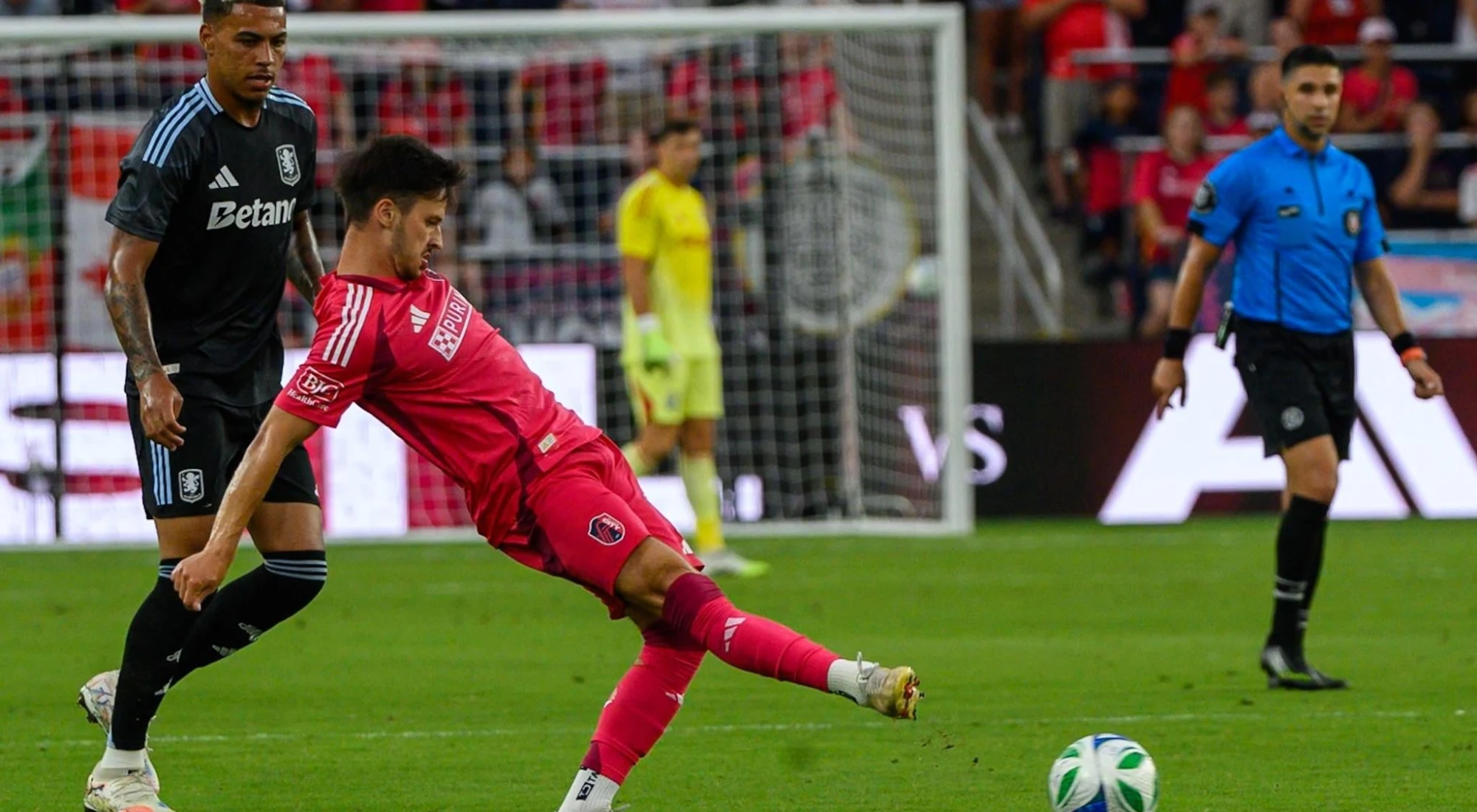

Football has always searched for certainty. Long before a ball is kicked, we instinctively begin categorising players. The striker scores goals. The winger stretches the pitch. The number ten creates. Positions have always been football’s simplest language, giving shape to a game that often feels chaotic.
Morgan Rogers doesn’t fit particularly comfortably into that language.
Officially, Aston Villa list him as an attacking midfielder or forward, yet neither description feels entirely satisfying. Spend ninety minutes watching him and the question of where he plays quickly gives way to something more interesting. One moment he’s receiving possession inside his own half before driving forty yards through midfield. The next, he’s taking the ball on the half-turn between the lines before slipping Ollie Watkins through on goal. A few minutes later, he’s arriving inside the six-yard box to finish the very move he helped create.
The obvious conclusion is to call him versatile. Perhaps that’s too simplistic. Versatility suggests someone capable of performing different jobs. Rogers rarely looks as though he’s changing jobs at all. The spaces change, the starting positions shift, but the football itself remains remarkably consistent. He receives under pressure, carries through contact, commits defenders and progresses attacks. Wherever Unai Emery places him, those qualities travel with him.
Maybe that’s what makes him feel so modern. Not because he can play in several positions. Because his defining qualities aren’t tied to one.
A Statement Against Arsenal
The best example arrived early in the 2024-25 season. Aston Villa lost 2-0 to Arsenal, yet by the final whistle Morgan Rogers had quietly announced himself. Phil McNulty of BBC Sport described him as Villa’s standout performer, praising the blend of “running power and dribbling skill” that repeatedly unsettled one of the Premier League’s best defences. Time and again Rogers received under pressure, rode challenges and drove Villa forty or fifty yards up the pitch, turning defensive situations into attacking ones almost single-handedly.
Months later, reflecting on that afternoon in an interview with The Athletic, Rogers admitted it was the moment everything changed. “I was playing against some of the best players in the world,” he said. “Being able to match them toe-to-toe… I just got that feeling: ‘Yeah, I can do this.'”
The scoreline belonged to Arsenal. The afternoon belonged to Morgan Rogers.
If that performance introduced him, the months that followed explained why it wasn’t an anomaly. Against Manchester United he carried Aston Villa to victory with two goals, repeatedly exposing transition spaces before finishing with the composure of a seasoned centre-forward. Liverpool couldn’t contain him either, as Rogers dictated one of Villa’s biggest victories of the campaign with a goal, an assist, four chances created and a flawless record in one-on-one situations. In the FA Cup against Nottingham Forest, he wasn’t simply the runner anymore. He became Villa’s chief creator, leading the side for progressive carries, chances created and passes into the penalty area before scoring himself.
Different opponents. Different competitions. Different tactical demands. The same defining quality.
Alex Moneypenny of The Different Knock describes this idea as a player’s “UO1” — the one attribute that survives regardless of system, league or opposition. Whether or not you adopt the terminology, it’s a useful way of thinking about football. Every elite player possesses something that travels. For Morgan Rogers, it isn’t pace alone, nor is it dribbling in isolation. It’s his ability to receive under pressure before carrying possession through contact and transforming defence into attack. Everything else in his game flows from that.
Finding Himself in the Football League
Interestingly, Rogers didn’t discover that quality in the Premier League. He discovered it by repeatedly being forced to adapt. Football has a habit of making successful careers appear inevitable. Looking backwards, every transfer feels like another step towards the top. Rogers’ story was far less straightforward.
Manchester City’s academy refined his technical ability, but senior football demanded something different. Lincoln City introduced him to the physical realities of men’s football. Bournemouth brought rejection, with opportunities disappearing almost as quickly as they arrived. At Blackpool, he experienced the pressure of relegation, where every mistake carried genuine consequence. Middlesbrough finally offered him the freedom to express everything those experiences had taught him.
Reflecting on his journey through the Football League in an interview with The Times, Rogers offered perhaps the most revealing assessment of his development. “I had to find myself as a player.” He also reflected on his time in the Championship, elaborating that “the player I am now is not who I was as an academy player”, recognising that academy football and senior football demanded entirely different versions of the same talent.
Each environment stripped away another assumption. Each one left him with something new. By the time Aston Villa signed him from Middlesbrough, they weren’t buying a winger who could fill in centrally. They were buying a footballer whose defining quality had survived every environment he had encountered.
Why Emery Understood Him So Quickly
Michael Carrick deserves enormous credit for moving him into more central areas at Middlesbrough, but Emery recognised something deeper. He wasn’t interested in forcing Rogers into a position. He saw a footballer whose greatest strength could influence games regardless of where he started.
Wherever I play on the pitch, he still wants me to be me.
Morgan Rogers on Unai Emery
It sounds like an understatement of sorts, yet it explains almost everything. Elite coaching isn’t always about changing players. Rather, about maximising potential. Emery has challenged Rogers to attack the six-yard box more often, improve his goalscoring numbers and become more ruthless inside the penalty area. What he hasn’t done is remove the freedom that makes him unique. Quite the opposite. During difficult spells, Emery persisted with Rogers because he understood that players capable of changing games inevitably lose the ball, attempt risky passes and occasionally make the wrong decision.
“I don’t play football to be boring, to be safe,” Rogers added. “Other players are better than me at that… I have qualities to unlock defences, to score goals and create goals. If that was safe to do, everyone would be able to do it.”
That isn’t arrogance. It’s responsibility. Safe football rarely breaks organised defences apart. Players tasked with creating chaos must accept that mistakes are part of the process. Rogers understands that his job isn’t simply to keep possession. His job is to move Aston Villa up the pitch, commit defenders and create moments that safer footballers never would.
Perhaps that’s why Morgan Rogers feels like the epitome of the modern footballer. Not because he lacks a position. Football will always have positions. What it increasingly values are players whose defining qualities remain valuable wherever the game asks them to begin.
For decades, we have categorised players, placing them in boxes in an attempt to understand footballers. Morgan Rogers suggests there is a better question. Put positions aside. Ask what makes them thrive. The answer usually tells you far more.